One innocent upgrade can make perfectly good things feel suddenly unacceptable.
Imagine buying a new sofa for €900.
It looks brilliant. Unfortunately, the coffee table you’ve liked for years now looks like it belongs in a student flat.
The rug feels tired. The lamp seems wrong. Even the artwork has somehow failed an exam nobody told it about.
By the time the room feels “finished”, your €900 sofa has become a €2,600 project.
Welcome to the Diderot Effect.
The dressing gown that started a spending problem
In the 18th century, French philosopher Denis Diderot received a beautiful scarlet dressing gown.
At first, it was just a lovely gift.
Then he looked around his home.
The new gown made his other possessions seem shabby by comparison. Furniture and everyday objects he had previously accepted no longer felt good enough.
He began replacing them, chasing a room that matched his new standard.
The story became an unusually expensive lesson in human behaviour.
The objects around him had stayed the same. His reference point had moved.
We still do this today.
We just have better delivery services.
How one purchase recruits five others
The pattern usually begins with a reasonable decision.
You buy something because it solves a problem, replaces something broken or simply makes you happy.
Then a second thought appears: “If I’m going to own this, shouldn’t I get the right things to go with it?”
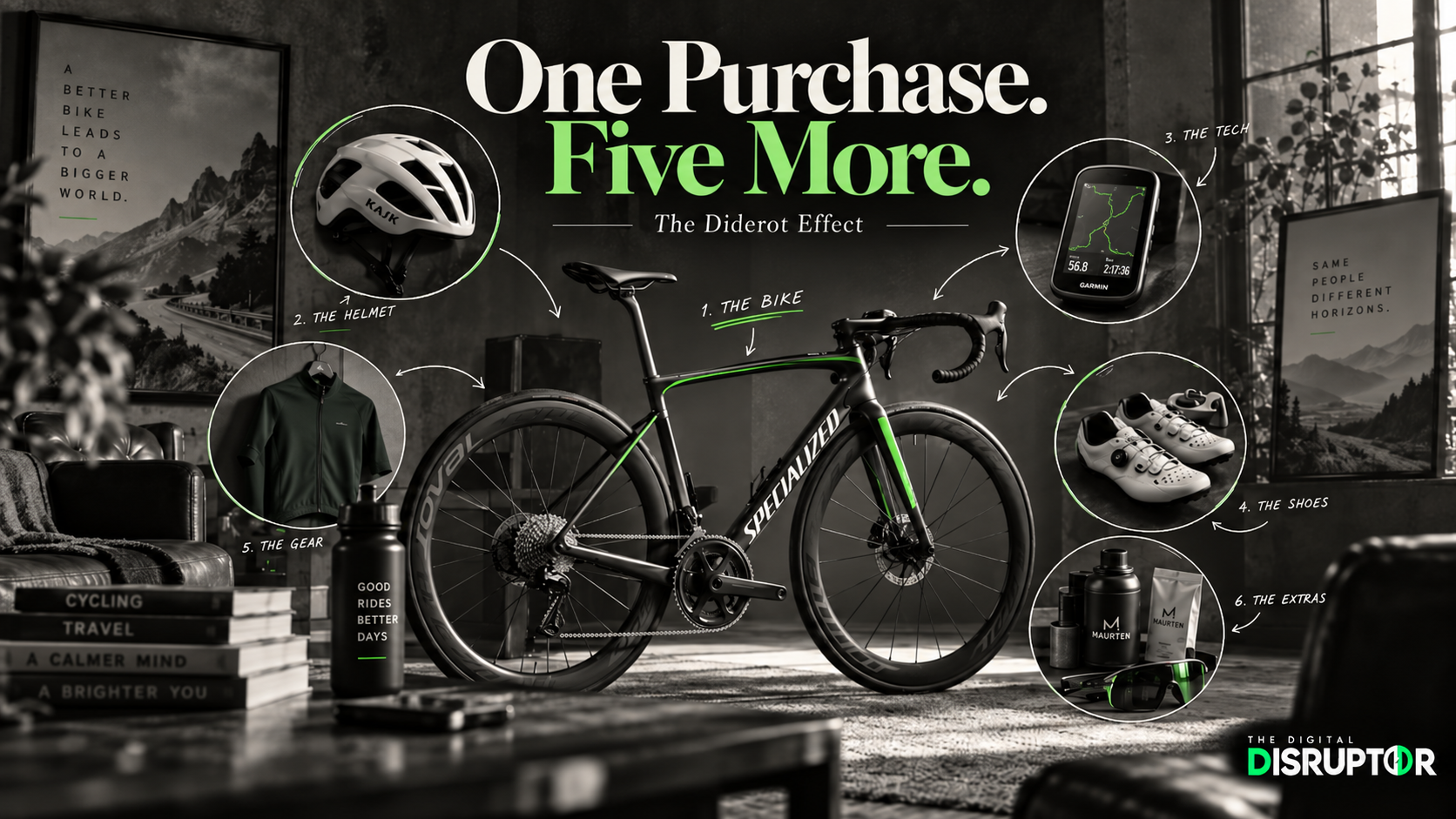
Consider a road bike.
You budget €1,200 for the bike. Sensible enough.
Now picture the growing list: shoes, pedals, cycling clothes, a GPS computer and sunglasses that apparently improve your personality at high speeds.
With illustrative prices, what began as €1,200 can become €2,150.
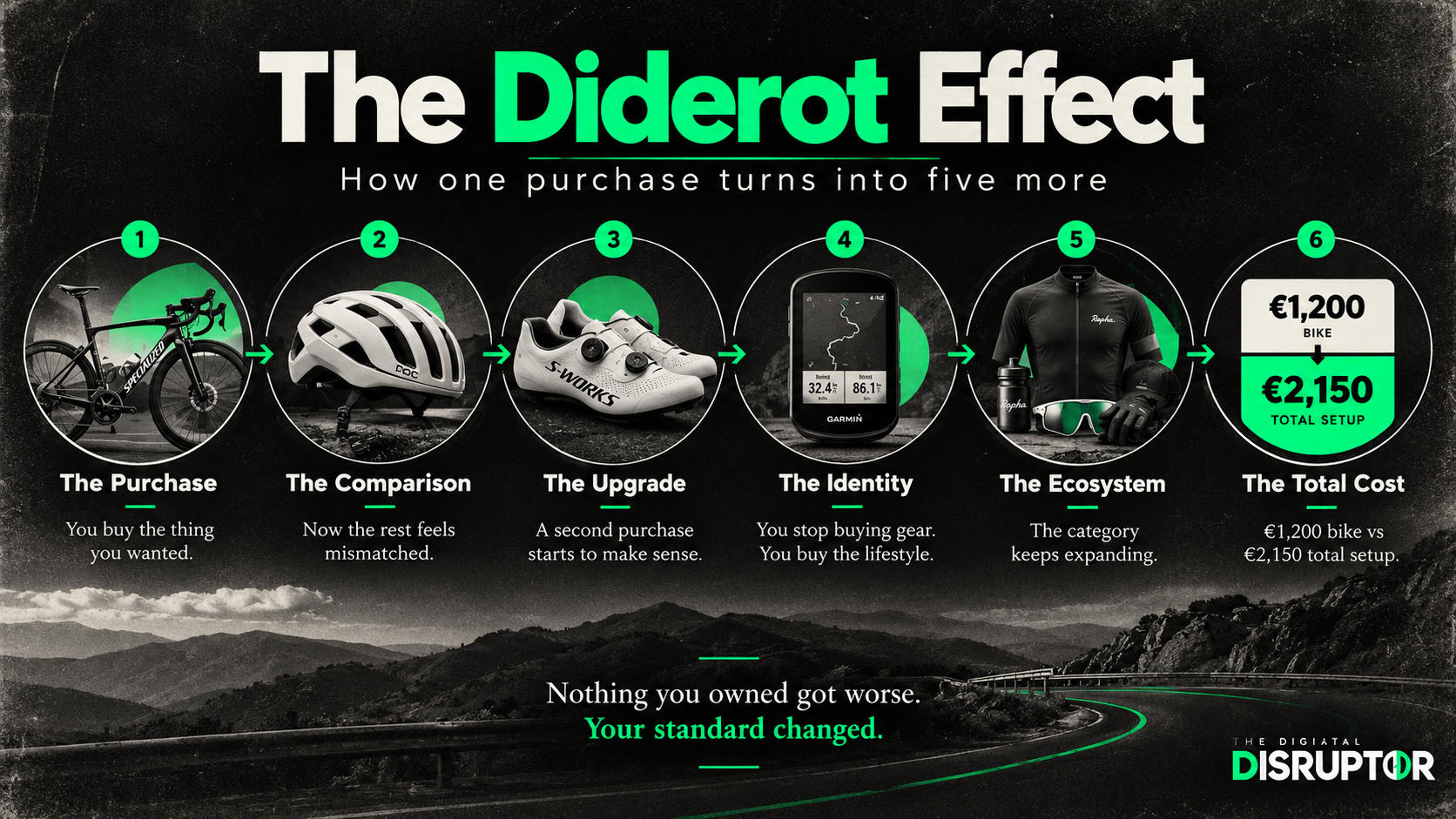
Some extras are practical. A properly fitted helmet and basic safety equipment matter.
But the €180 matching jersey versus the €35 one that does the same job tells a different story.
The spending has moved from function towards feeling like you belong.
The same pattern shows up at home.
A new desk makes the chair look wrong. The new chair makes the monitor seem ancient. The monitor arrives, and now the lighting needs attention.
A €300 desk versus a €1,100 workspace is a surprisingly short journey.
And yes, the emails still look exactly the same.
The things we buy bring identities with them
The most interesting part happens when the purchase begins to change the story we tell ourselves.
Buy a camera and you might become “someone who is serious about photography”.
Buy a premium coffee machine and suddenly coffee isn’t a drink. It’s a hobby with cleaning rituals.
Buy a record player and a casual interest in music can evolve into opinions about speaker placement.
I could turn a €200 turntable into a €900 argument about sound quality before I’ve even played a full album.
None of those hobbies is a problem.
They can bring real pleasure, skill and community.
The trouble begins when the identity comes with a shopping list, and we confuse completing that list with becoming better at the thing itself.
Owning more photography equipment won’t automatically make you notice better photographs.
A more expensive cycling computer won’t make you enjoy every ride.
And the right speakers still can’t rescue my questionable taste in music.
Why the mismatch feels so powerful
We rarely judge an object on its own.
We compare it with what sits beside it, what we see online and what we think someone like us should own.
That comparison is constantly changing.
A perfectly good coat can feel old after we buy newer shoes. The shoes haven’t damaged the coat. They’ve changed the picture in our head.
This is also why the effect spreads so easily across a room, an outfit or a hobby.
We like things to fit together.
A mismatch creates a small irritation, and buying something promises to remove it.
The irritating part is that the relief may be temporary.
The next purchase can create the next mismatch.
That is a remarkably efficient way to turn satisfaction into another invoice.
Marketing makes the chain easier to follow
Brands understand that we don’t always shop for isolated objects.
We often shop for a complete version of something.
A phone comes with suggested accessories.
A skincare product sits inside a recommended routine.
A running shoe leads to watches, clothing, hydration gear and accessories designed around the same lifestyle.
Online shops make the next step especially convenient.
“Complete the look” and “Frequently bought together” are small phrases with a large job.
They suggest that your original choice is somehow incomplete.
Sometimes the suggestion is helpful.
A protective case for a new phone serves an obvious purpose.
But a matching charger, matching stand and matching travel pouch may be selling a feeling of completeness rather than much extra value.
For marketers, the Diderot Effect is a useful lesson in how people make decisions.
For buyers, it is a reminder that a smooth shopping experience and a good purchasing decision are not always the same thing.
A simple way to spot the chain reaction
I don’t think the answer is to stop buying nice things.
If you can afford an upgrade and it improves your life, enjoy it.
The problem is the automatic purchases that follow.
Before adding the next item to your basket, try a few checks.
- Separate the need from the mismatch. Does the old thing fail at its job, or does it merely look less impressive next to the new one?
- Price the whole decision. Compare the original purchase with the likely total. €700 versus €1,450 is a different commitment from the number on the first price tag.
- Give the new purchase time to settle. A 48-hour pause versus a five-minute checkout can make the supposed emergency look fairly ordinary.
- Don’t confuse equipment with progress. Ask whether the next accessory helps you actually do more, or simply helps you look like someone who does.
I find the final check especially uncomfortable.
It’s much easier to buy a notebook than to write something worth putting in it.
The upgrade that costs nothing
The Diderot Effect doesn’t mean every extra purchase is foolish.
It means one new object can quietly rewrite the rules for everything around it.
And because the rules changed in our heads, the spending can feel perfectly logical while it’s happening.
The next time a new purchase makes your old possessions look disappointing, give them another look.
They were doing their job yesterday. They probably still are.
P.S. I’m The Digital Disruptor. Curious about the stories behind brands, beats, places and people. I write about marketing, music, travel, comics and whatever else catches my attention. I call it curiosity. My 47 open browser tabs suggest otherwise.
P.S.2 You are reading this on a Friday. That is intentional. Have a great weekend!